
CO₂ Cold Room: The Green Revolution for Your Commercial Kitchen



For decades, commercial cold storage units have relied on fluorinated refrigerants, which have devastating effects on the climate. Today, a clean, efficient, and sustainable alternative is gaining traction: CO₂ cold storage units.
The problem with traditional refrigerants: a silent climate bomb
All commercial kitchens have a cold room. These essential pieces of equipment— refrigerated rooms for storing fresh food and freezer rooms for deep-freezing—are at the heart of every restaurant, catering business, or institutional kitchen. However, for years, the industry has relied heavily on synthetic refrigerants: HFCs (hydrofluorocarbons).
These gases have a very high Global Warming Potential (GWP). Some HFCs commonly used in commercial refrigeration, such as R404A or R410A, have a GWP several thousand times higher than that of CO₂. In other words, a leak of just a few hundred grams is equivalent to the emission of several tons of CO₂ equivalent into the atmosphere.
In response to this climate emergency, European regulations have tightened their requirements. The F-Gas Regulation (fluorinated gases) has governed the use of HFCs for several years and calls for their phase-out by 2030–2050 for applications where alternatives exist. For professionals in the restaurant and hospitality industries, the question is therefore no longer whether to make the switch, but when and how.
The situation also creates operational and regulatory complexity for operators: mandatory certifications for handling refrigerants, required periodic inspections, record-keeping requirements, the risk of penalties, and more. The burden of compliance has become a daily struggle for restaurant owners whose core business is, above all, cooking.
CO₂ cold storage: natural technology for optimal performance
CO₂ (carbon dioxide, or R744 in refrigeration terminology) is one of the oldest natural refrigerants. In fact, it was used in refrigeration as early as the 19th century, before being replaced by synthetic refrigerants. Today, technological advances allow it to be used with unmatched efficiency and reliability.
Unlike HFCs, CO₂ has a Global Warming Potential of 1 and an Ozone Depletion Potential (ODP) of zero. In the event of a leak, its impact on the climate is therefore virtually zero.
LocaCuisines now offers CO₂-powered cold rooms, an eco-friendly alternative to traditional models. CO₂-powered cold rooms have no environmental impact, making them a sustainable and eco-friendly solution.

The environmental benefits of CO₂ cold storage rooms
A refrigerant with virtually zero climate impact
The first environmental benefit is fundamental : CO₂ is a naturally occurring gas found in the atmosphere. With a GWP of 1, any accidental leak does not significantly contribute to global warming. This is a significant difference from HFCs, whose GWP can exceed 3,000.
Long-term regulatory compliance
By choosing CO₂, operators can avoid future regulatory bans. The F-Gas Regulation imposes increasingly strict restrictions on HFCs with high GWP values. Choosing a CO₂ cold storage room today means opting for long-lasting equipment that won’t require costly upgrades in the future.
Consistency with the institutions' CSR initiatives
More and more food service establishments are adopting CSR initiatives: waste reduction, local sourcing, energy conservation, and more. Choosing a CO₂ cold room is a natural fit within this broader framework of environmental sustainability. It strengthens a brand’s image among customers and partners who are increasingly concerned about climate issues.
The tangible benefits for the customer: performance, peace of mind, and control
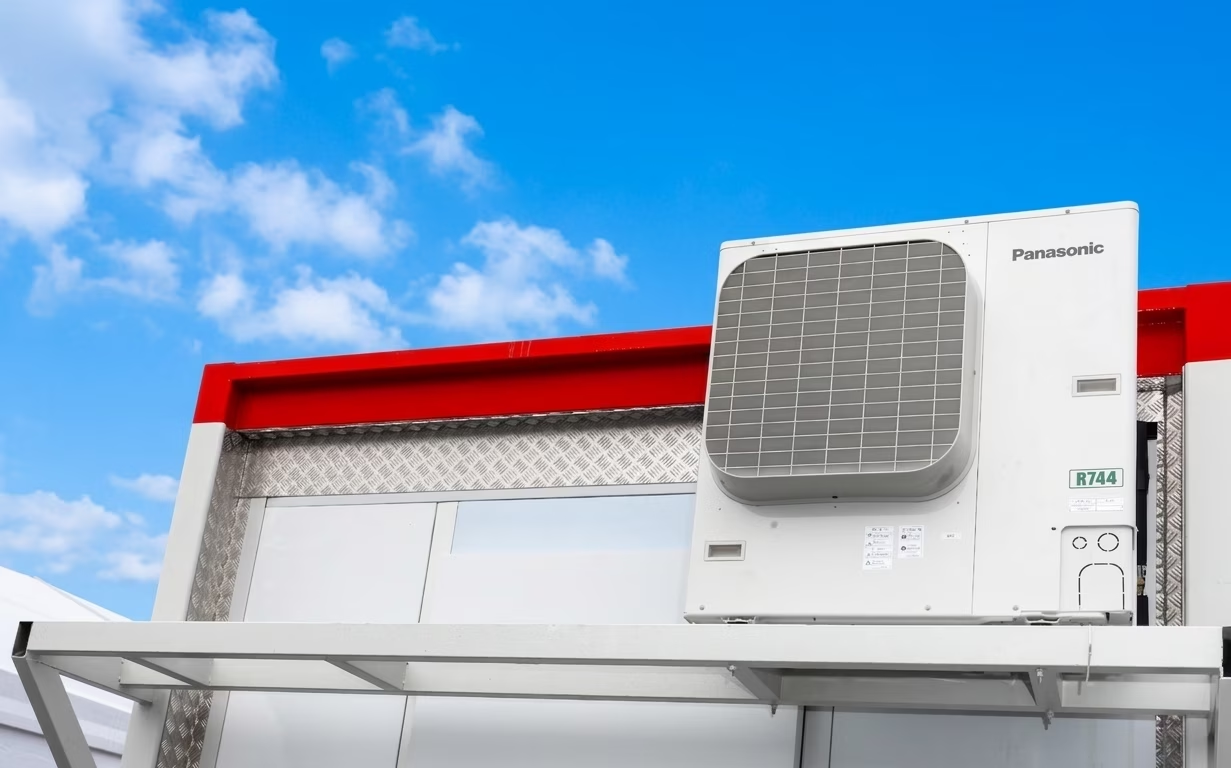
In light of pressing regulatory and environmental challenges, LocaCuisines has chosen a leading partner: Panasonic, one of the few companies in the European market to offer professional refrigeration systems that run entirely on CO₂. This strategic partnership enables LocaCuisines to integrate into its kitchen modules a refrigeration solution that is both eco-friendly and high-performance, while fully complying with current and future F-Gas regulations.
Technology designed for demanding professionals
The system uses R744 refrigerant, which is natural CO₂. Compared to R404A (the traditional HFC refrigerant still widely used in commercial kitchens), R744 delivers greater energy savings while emitting significantly less CO₂ over the equipment’s entire lifecycle. This offers a twofold benefit: environmental first, financial second.
At the heart of the system, a powerful two-stage rotary compressor ensures high performance year-round, regardless of the season. The unit is designed to operate in an outdoor temperature range of -15°C to +43°C, making it perfectly suited to European climatic conditions—including during increasingly frequent heat waves. A microprocessor-based control system automatically adjusts the speed of the outdoor fan based on ambient conditions, thereby continuously optimizing the system’s efficiency without human intervention.
Acoustic comfort for a better work environment
One of the often-overlooked advantages of CO₂ systems is their quiet operation. With a noise level measured at 55 dB(A) at a distance of 1 meter, these units are among the quietest on the market. For kitchens located in urban areas, near dining areas, or in sensitive facilities (hospitals, schools, hotels), this acoustic advantage is far from trivial.
No impact on the environment, a positive impact on your bill
For LocaCuisines, the decision to use CO₂ is not merely a response to regulatory requirements: it is a commitment upheld at the highest levels of the company. Refrigerants are a major source of pollution. The goal is clear: to offer customers cold rooms with zero environmental impact.
And this commitment to the environment does not come at the expense of the economy. A CO₂ chiller unit consumes less electricity to operate than one running on traditional HFCs. For the customer, this translates into a direct and lasting reduction in their energy bill.

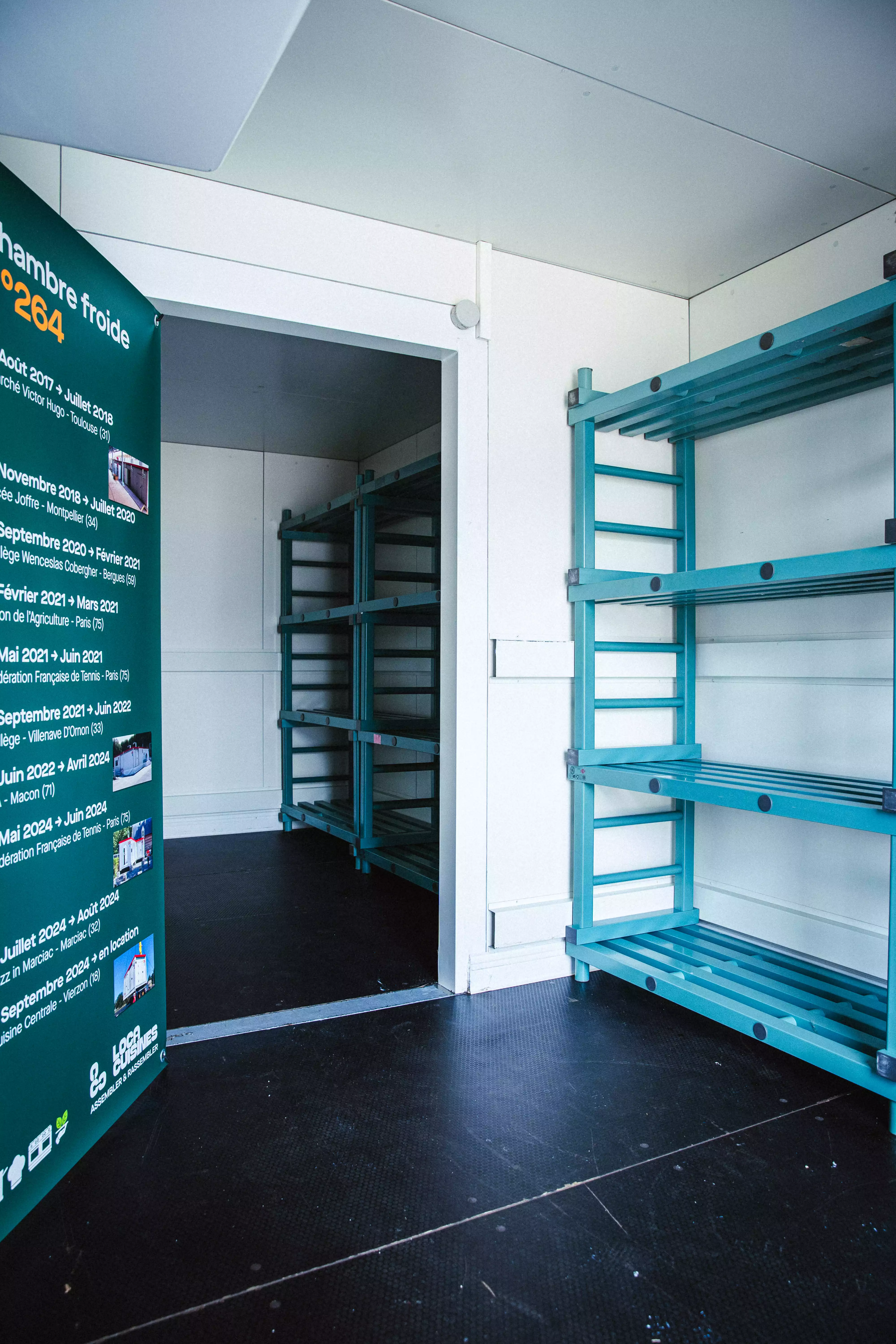
Why choose a CO₂ cold room when renting through LocaCuisines?
Choosing a CO₂ cold room as part of a LocaCuisines rental is a practical decision that yields immediate results: in terms of energy consumption, corporate image, and the company’s commitments.
Use less energy, starting from day one. A CO₂ unit rented from LocaCuisines uses less electricity than a unit powered by traditional HFC refrigerants. Over the course of the rental period, this difference is directly reflected in your energy bill.
Take concrete action to protect the environment. Unlike HFC refrigerants, whose Global Warming Potential can exceed 3,000 times that of CO₂, R744 has virtually no impact on the climate in the event of a leak. Even in a temporary installation, every day a CO₂ cold room is in operation is a day without polluting emissions.
Reducing your carbon footprint, even over a short period. For companies that track their emissions, using CO₂ refrigeration equipment directly contributes to reducing Scope 3 emissions. It’s a simple solution that requires no upfront investment, and leasing makes it accessible to everyone.
Promote this to partners and service providers. Local governments, large corporations, healthcare facilities, and event organizers: many LocaCuisines clients are subject to CSR objectives or environmental clauses in their contracts. Being able to certify that the rented kitchen is equipped with a cold room that has zero environmental impact is a concrete, documented, and valuable selling point for their own stakeholders, clients, and end customers.


.png)





.webp)
.avif)



.avif)

%20(1).avif)

.avif)