
.png)
CSR Initiative and 2025 Carbon Footprint Assessment: Low-Carbon Modular Kitchens



By 2026, CSR will no longer be an option for local governments and businesses —it will be a legal requirement and a driver of competitiveness. Yet one major source of emissions is often underestimated: food service infrastructure. At LocaCuisines, the French leader in temporary modular kitchens, we’re proving that modularity is the key to low-carbon food service. Our 2025 carbon footprint report shows a 45% reduction in emissions over two years, with just 210 g CO₂e per meal.
Why this article?
- Understanding CSR obligations (BEGES, CSRD) and their impacts.
- Analyzing our 2025 carbon footprint report and its key takeaways.
- Identify modular solutions to reduce your footprint.
- Take concrete action using a structured approach.
LocaCuisines 2025 Carbon Footprint: 45% Reduction in Emissions in 2 Years
In 2026, LocaCuisines published its comprehensive carbon footprint assessment, conducted in accordance with the ADEME/Bilan Carbone V9 methodology. The results are impressive: a 45% reduction in emissions in just two years. The 2025 carbon footprint assessment was conducted in collaboration with an independent specialist firm, CLIMAT LOCAL.
Key figures: 2,154 tCO₂e vs. 3,929 tCO₂e (2023)
- 2023: 3,929 tCO₂e (baseline data).
- 2025: 2,154 metric tons of CO₂e
- Reduction: 45%, or 1,775 tCO₂e less over 2 years.
→ This discount is equivalent to:
- 10 million km by car (1 tCO₂e = 5,000 km).
- The annual consumption of 400 French households (1 household = 5.5 metric tons of CO₂e per year).
Key Ratios for 2025:
- 184 kgCO₂e per k€ of revenue (2025 revenue: 11.7 M€).
- 50 tCO₂e per employee (workforce: ~43 employees).
- 210 gCO₂e per meal (10.5 million meals produced).
Breakdown by Scopes and Transmitter Stations
Our carbon footprint covers all emissions, in accordance with the GHG Protocol:
- Scope 1 (Direct Emissions): ~12% of total emissions. Actions: Electric vehicles, optimizing travel...
- Scope 2 (Energy): ~8% of emissions. Actions: Switching to green electricity, improved insulation...
- Scope 3 (Other indirect emissions): ~80% of emissions. Main sources: Purchasing, logistics, module usage. Actions: Reuse of modules, optimized logistics, low-carbon equipment...
→ Scope 3, which is often overlooked, accounts for the largest share. This is where our modular solutions make a difference.
Why CSR Will Become Mandatory for Local Governments and Businesses in 2025–2026
The environmental transition is accelerating, and regulatory requirements are becoming stricter. For local governments and businesses, CSR is no longer just a marketing tool, but a strategic and legal necessity.
Legal Requirements: BEGES, CSRD, and Local Governments
In 2026, two major frameworks will govern organizations' carbon responsibility:
- The BEGES (Greenhouse Gas Emissions Inventory) :
- Required for:
- Companies with 500 or more employees (or 250 or more for local governments).
- Public institutions (hospitals, schools, cafeterias).
- Scope: Direct emissions (Scope 1) and indirect emissions (Scope 2 and 3).
- Penalties: A fine of up to €10,000 for noncompliance.
- Required for:
- The CSRD (Corporate Sustainability Reporting Directive) :
- Effective as of 2024 for large companies (criteria: 250 or more employees, €40 million or more in revenue, or €20 million or more in total assets).
- To be extended to publicly traded SMEs in 2026.
- Requirement: Publication of a sustainability report aligned with the European Sustainability Reporting Standards (ESRS ).
For local governments:
- The AGEC Act (2020) and the Tertiary Sector Decree (2019) require a 40% reduction in energy consumption by 2030 for public buildings.
- Institutional kitchens (school cafeterias, nursing homes, hospitals) are directly affected.
→ By 2025, failing to incorporate CSR into your strategy will put you at risk of penalties and losing public contracts.
The Business Benefits of a Structured CSR Approach
A proactive CSR approach yields tangible benefits:
- Access to Public Procurement: An Elimination Criterion in 80% of Bids.
- Cost Reduction: Energy Savings and Resource Optimization.
- Image and Appeal: Enhancing Reputation and Building Stakeholder Loyalty.
- Regulatory Resilience: Anticipating Future Requirements.
- Attractive Financing Options: Access to grants (ADEME, regional governments, the European Union).
→ CSR is not a cost, but a profitable investment in both the short and long term.
The Often-Overlooked Role of Food Service Infrastructure
Few organizations measure the carbon footprint of their food service infrastructure, even though it accounts for:
- 15 to 25% of a commercial building’s carbon footprint (source: ADEME).
- Up to 30% of emissions from local government facilities (school cafeterias, nursing homes, hospitals).
Why does this station have such a strong signal?
- Construction: A built-in kitchen emits 500 to 1,000 kg CO₂e/m² (concrete, steel, equipment).
- Operations: Energy, water, and waste generate recurring emissions.
- Maintenance: Renovations, equipment replacements, etc.
The solution? Temporary modular kitchens, which allow you to:
✅ Avoid construction (and its associated emissions).
✅ Reuse the modules across multiple sites.
✅ Optimize energy use with high-performance equipment.
How to Measure the Carbon Impact of Temporary Food Service Infrastructure
To assess and reduce the carbon footprint of your infrastructure, you need to understand the scopes and apply a rigorous methodology.
The Three Scopes You Need to Master (1, 2, 3)
- Scope 1: Direct emissions. Examples: Gas combustion, vehicle fuels. Share of the carbon footprint: 10–20%.
- Scope 2: Indirect energy-related emissions. Examples: Electricity, heating, air conditioning. Share of the carbon footprint: 10–15%.
- Scope 3: Other indirect emissions.Examples: Purchases (materials, equipment), logistics, use, end-of-life. Share of the carbon footprint: 65–80%.
→ Scope 3 emissions are the most complex to measure, but also have the greatest impact.
Carbon Footprint V9 Methodology and ADEME Regulations
To ensure your carbon footprint assessment is compliant, follow the Bilan Carbone® V9 (ADEME) methodology:
- Define the scope :
- Organizational: Which entities are included?
- Operations: Which sites, activities, and equipment?
- Time frame: Data covering 1 year (fiscal year).
- Collect data :
- Bills (electricity, gas, fuel).
- Mileage (vehicles, deliveries).
- Purchases (materials, equipment, services).
- Calculate Emissions :
- Use the ADEME emission factors.
- Example: 1 kWh of electricity = 0.05 kgCO₂e (French energy mix).
- Analyze and Prioritize :
- Identify the positions with the highest emissions.
- Develop an action plan (reduction, offset).
→ ADEME recommends conducting a carbon assessment every two years to track progress.
Modular Solutions: A Low-Carbon Alternative to Built-In Kitchens
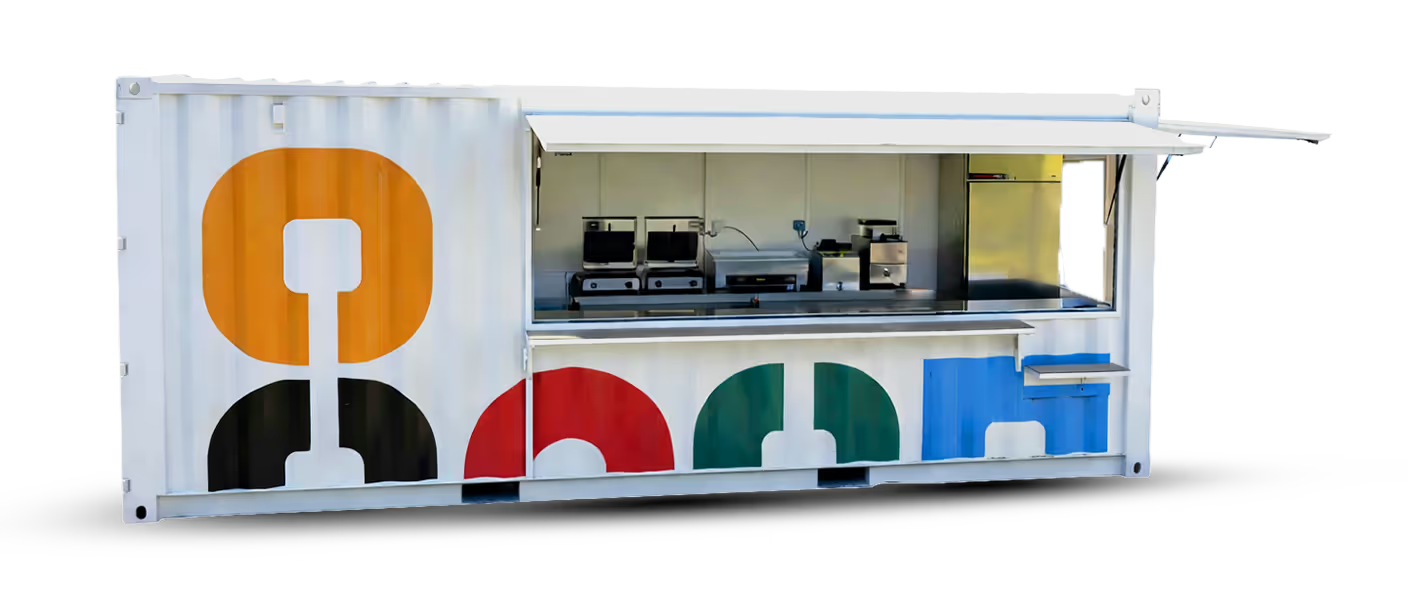
Modular kitchens aren't just practical and quick to set up —they're also the lowest-carbon solutions for temporary or permanent food service.
Why Modularity Equals Carbon Efficiency
- Construction :
- Modular kitchen: Prefabricated in a workshop.
- Permanent kitchen: On-site (concrete, steel).
- Materials :
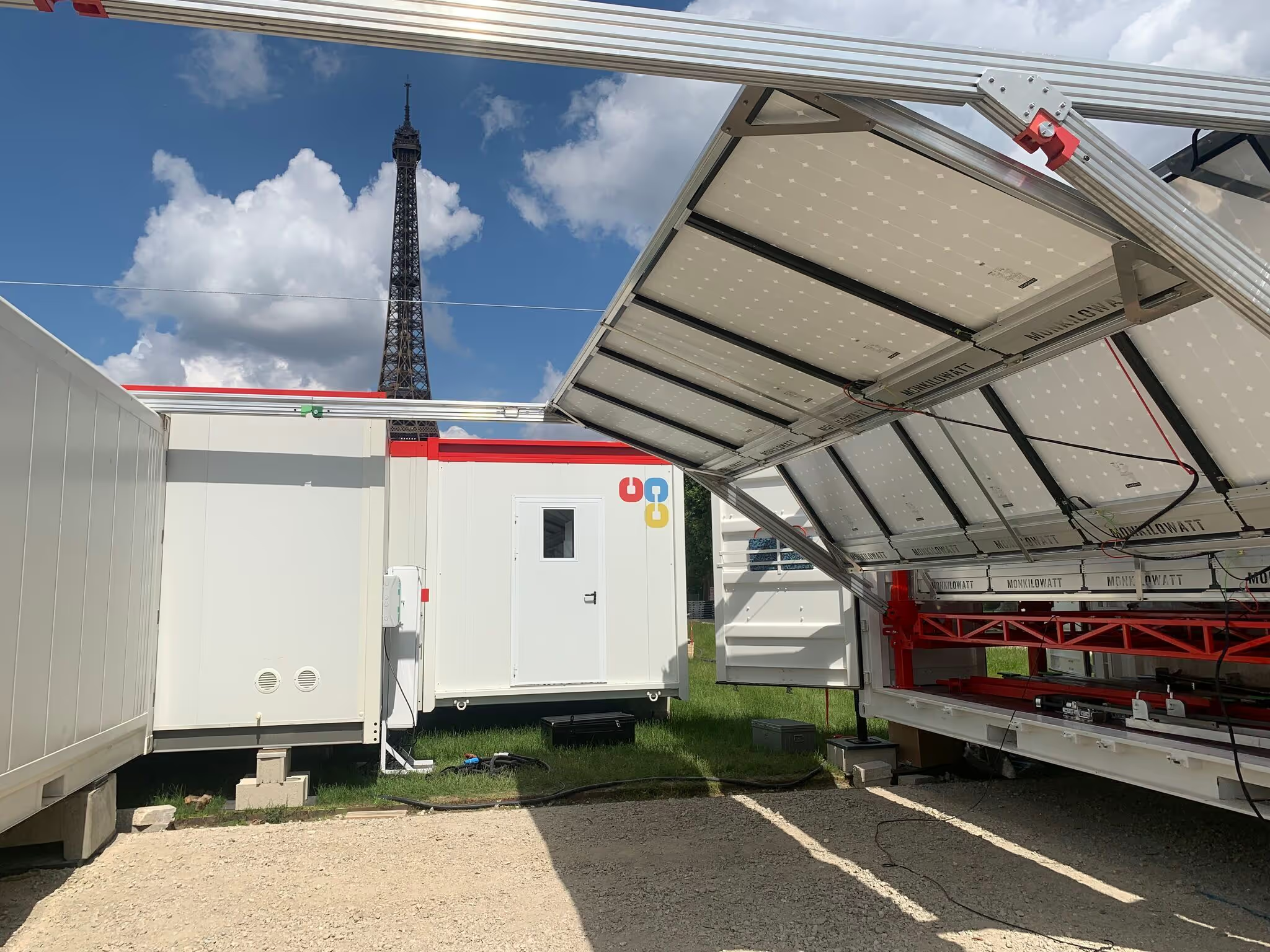
- Modular Kitchens: Reuse and Solutions with Solar Panels Available
- Built-in kitchen: Concrete and standard steel used exclusively for this kitchen
- Modular advantage: Uses fewer resources.
- Service Life :
- Modular kitchens: 20 years and older.
- Built-in kitchen: 20–30 years.
- Modular advantage: Can be reused at multiple sites. Rental duration tailored to your exact needs.
- Professional equipment:
- Modular kitchen: incorporates low-carbon materials, tailored to specific needs.
- Built-in kitchen: equipment quickly becomes obsolete; there's no need to use everything (inventory)
- Flexibility :
- Modular kitchen: Customizable in size and features.
- Built-in kitchen: Built-in.
- Modular advantage: Prevents oversizing.
- Disassembly :
- Modular kitchen: 100% recyclable and reusable for other projects.
- Built-in Kitchen: Complex Deconstruction.
- Modular Advantage: Environmentally Responsible End-of-Life Management.
Logistics Routes and Transportation Impact
Logistics is a key factor in reducing the carbon footprint. At LocaCuisines:
- Strategic warehousing: 2 warehouses in France to minimize distances.
- Consolidated shipping: Up to 2 modules per truck
- Low-carbon vehicles: 40% of trips are made using OLEO 100 (biofuel)
LocaCuisines: A French leader committed to decarbonization
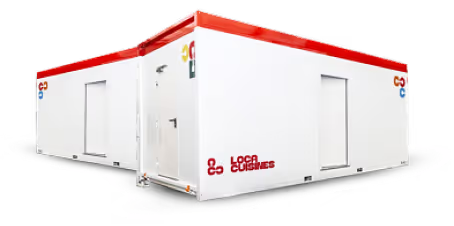
With over 30 years of experience and 700 modules available, LocaCuisines is the go-to partner for low-carbon modular food service solutions.
30 years of experience + EcoVadis Platinum and Coq Vert certifications
- 30 years of expertise: France’s leading provider of modular kitchens.
- 700 modules: The largest fleet in France.
- Certifications :
- EcoVadis Platinum (top 1% of companies evaluated).
- Coq Vert Label (exemplary environmental practices).
- Made in France: 100% made in France (workshops in Île-de-France and Occitanie).
→ Recognized expertise and a concrete commitment to corporate social responsibility.
Made in France, French technical teams
- Workshops in France: Locally designed and manufactured.
- 100% French technical teams: Engineers, technicians, logistics specialists.
- Unique expertise: Modularity, sustainability, energy efficiency.
→ A 100% French value chain for a controlled carbon footprint.
Comprehensive support: design, manufacturing, installation, and maintenance
We support our clients from start to finish:
- Study: Carbon audit and customized sizing.
- Manufacturing: Custom modules (size, equipment, standards).
- Installation: Disassembly, transport, assembly.
- Maintenance: Technical monitoring and energy optimization.
- Disassembly: Recycling and Reuse.
→ A turnkey service for hassle-free low-carbon catering.
FAQ - Carbon Footprint and Modular Catering
1. What is the carbon footprint of a LocaCuisines modular kitchen?
Our modular kitchens emit 210 g CO₂e per meal. This result is achieved through:
- An optimized design (reusable modules, sustainable materials).
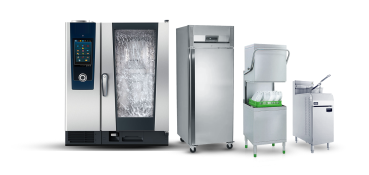
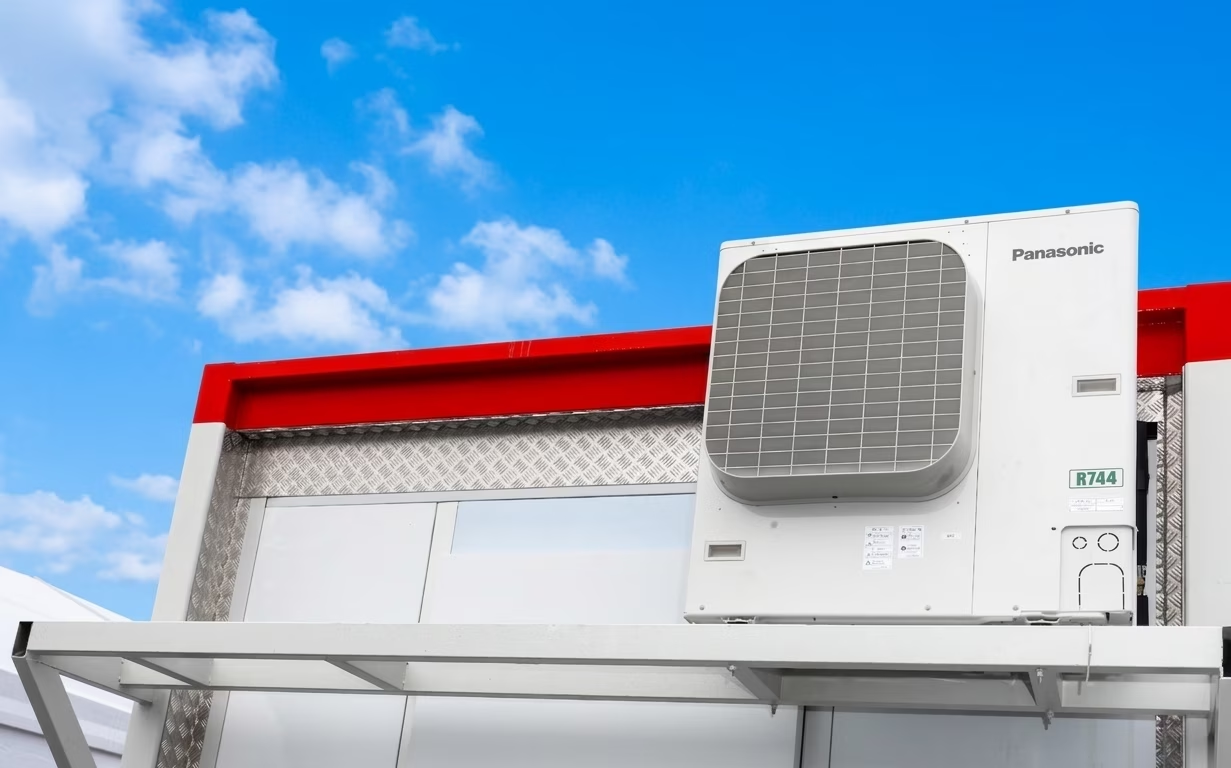
- High-performance equipment (ovens, baking sheets, low-carbon ventilation systems).
- Streamlined logistics (consolidated shipping, strategic locations).
2. How can I measure the carbon footprint of my institutional kitchen?
To measure your kitchen's carbon footprint, follow these steps:
- Define the scope (Scope 1, 2, 3).
- Collect data (energy bills, mileage, purchases).
- Calculate emissions using ADEME factors.
- Analyze and prioritize the source positions.
3. How does LocaCuisines reduce its carbon footprint?
We focus on three key areas:
- Design: Reusable modules, sustainable materials.
- Operations: Green energy, high-performance equipment.
- Logistics: Optimized transportation, low-carbon fleet.
5. What are the CSR obligations for local governments in 2025?
By 2026, local governments must:
- Conduct a BEGES (if there are 250 or more employees).
- Comply with the AGEC law (a 40% reduction in energy consumption by 2030).
- Incorporate CSR criteria into public procurement.
📩 Would you like to set up a temporary kitchen? Contact our teams to learn more and get the carbon footprint of your project.






.webp)
.avif)



.avif)
%20(1).avif)

.avif)