
.avif)
Temporary modular kitchen for Helen Catering
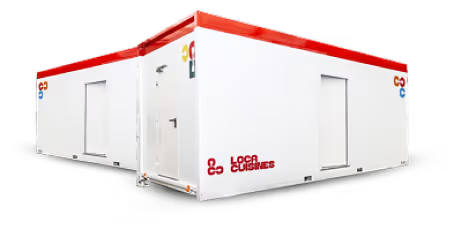
- 4 technical modules
- Up to 500 place settings per service
- Installed in 10 days
- Set up quickly just a few days before the holidays to keep business running


Helen Traiteur: Half a Century of Fine Dining in the PACA Region
Founded more than fifty years ago in Morières-lès-Avignon in the Vaucluse (84), Helen Traiteur is one of the most established catering companies in the PACA region. Specializing in gourmet receptions (weddings, corporate cocktail parties, large-scale private events), the company prepares up to 500 meals daily in its professional kitchens. This volume requires a continuous production line, well-organized kitchen teams, and a precisely scaled facility.
When a disaster suddenly strikes a production facility, the entire business is put at risk. Orders in progress, contracts signed months in advance, a reputation with customers built over five decades—everything can be jeopardized in a matter of hours. Faced with this emergency, Helen Traiteur turned to LocaCuisines to keep production running without delay and without any visible disruption to its customers.
The solution implemented: a temporary kitchen consisting of four fully equipped modules
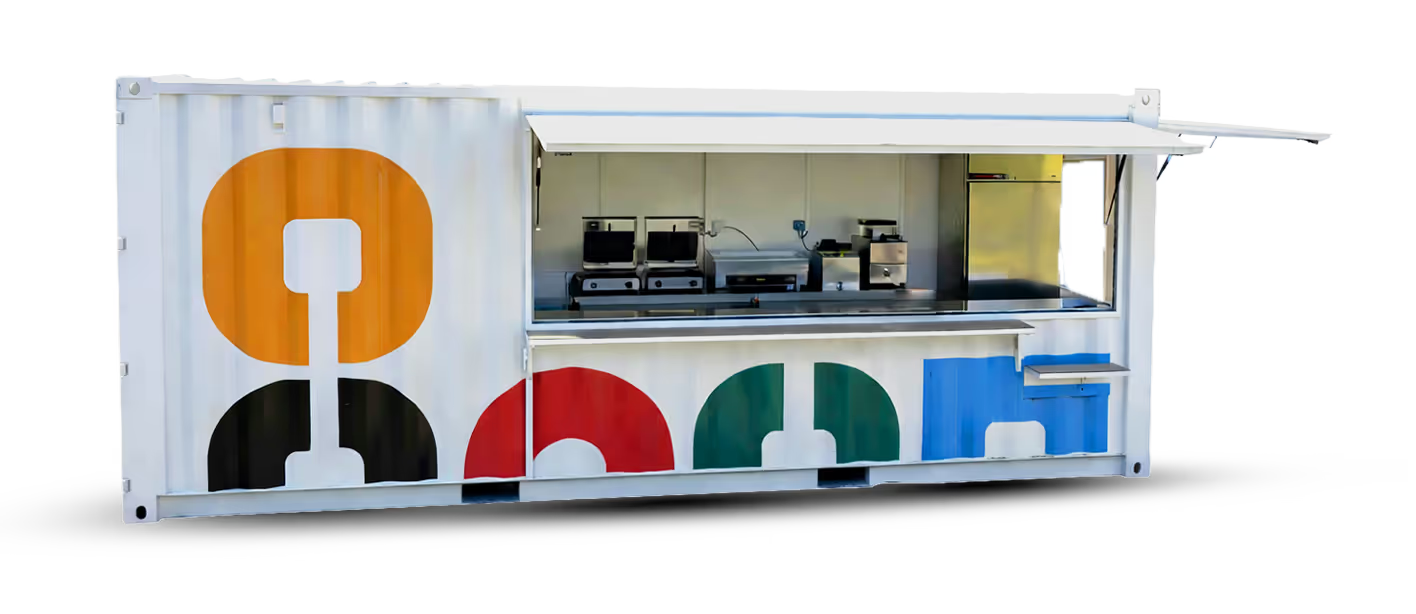
In response to the emergency, LocaCuisines designed and delivered a system consisting of four standalone modules that together form a complete, immediately operational professional kitchen. Each module performs a specific function in the production line: horizontal cooking, vertical cooking, dishwashing, and cooling. The entire system was sized to handle a production volume of 500 meals per day without compromising hygiene standards, equipment quality, or the ergonomics of the kitchen staff on duty.
Horizontal Cooking
One of the modules houses all the flat-top cooking equipment needed for mass production. It includes high-powered burners, gas or induction cooktops suitable for cooking large quantities simultaneously, as well as sauté pans b
Vertical Cooking
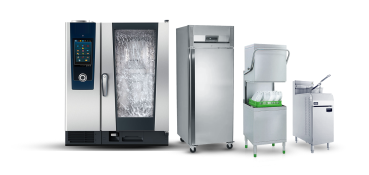
Combination steam and convection ovens are at the heart of this second module. This technology allows for simultaneous cooking on multiple levels (roasts, fish, poultry, braised vegetables) with temperature precision to the degree and humidity control via steam injection. The module is loaded with standard GN 2/1 gastronorm containers—the universal size in professional catering—ensuring full compatibility with the kitchen equipment already used by the Helen Traiteur team. For a gourmet caterer hosting large-scale events, vertical cooking is essential for high-quality, large-scale production.
Professional Dishwashing
The dishwashing area is often underestimated when designing a temporary kitchen, even though it represents a critical bottleneck in high-volume production. This module is equipped with a commercial dishwasher, large stainless-steel soaking tubs, and a sorting and pre-rinsing area designed to handle the volume generated by 500 meals per day. Compliant with HACCP standards, the dishwashing area ensures the traceability of cleaning and disinfection processes and the rapid return to service of cookware and serving equipment.
Refrigeration and the Cold Chain
A blast chiller is an essential piece of equipment required by regulations in any professional kitchen handling high-volume production. This unit reduces the temperature of cooked dishes from +63°C to +10°C in less than two hours, and to a core temperature of +3°C in less than four hours, in accordance with European health regulations (Regulation (EC) No. 852/2004). It also includes positive and negative temperature-controlled chambers for storing raw ingredients, intermediate preparations, and finished products while strictly maintaining the cold chain.
.avif)
.avif)
.avif)
An emergency deployment, without compromising production
The unique challenge of a post-disaster response lies in the time constraints: every hour of production downtime means unserved customers, compromised orders, and direct financial loss for the business. LocaCuisines has structured its deployment process specifically to meet this requirement. From the initial contact to the commissioning of the temporary kitchen, the response time is extremely fast, covering the design, on-site delivery of the modules, their connection to utilities, heat-up tests, and operational validation with the kitchen staff.
At Helen Traiteur, the system was delivered and made operational within a few days, allowing the teams to resume their normal production schedule the very next day after installation. The 500 daily meals were served without any disruption to service, without compromising culinary quality, and without any visible impact on customers attending gourmet receptions held in the PACA region. With peace of mind restored, management and staff were able to focus on what matters most: fine dining and customer satisfaction.
.avif)
.avif)
.avif)
Why use a modular design for a temporary kitchen of this capacity?
Each module is designed to operate independently or in direct connection with adjacent modules, following a workflow modeled after the natural flow of a professional kitchen team: receiving raw ingredients, preliminary preparation, cooking, cooling, and dishwashing. This linear layout reduces internal travel times, minimizes the risk of cross-contamination between clean and dirty areas, and prevents losses in operational efficiency during peak production periods.
Modularity also allows for precise adjustment of the installed area. For 500 meals per day in a catering operation, 4 modules are sufficient to cover all critical functions.
The Challenges of Business Continuity for a Fine-Dining Catering Company of This Size
For a caterer like Helen Traiteur, a professional kitchen is not merely a piece of infrastructure: it is the productive heart of the business and the foundation of all its commercial commitments. Unlike traditional commercial restaurants, where it is theoretically possible to close the dining room during renovations, a caterer that organizes events is bound by firm contracts, often signed several months in advance. An incident does not give the right to unilaterally terminate these commitments without legal and reputational consequences. Business continuity is not an option; it is a contractual and commercial obligation.
The temporary modular kitchen directly addresses this need: it replicates, in a temporary space, the full range of production capabilities required, using professional-grade equipment equivalent to that of a permanent kitchen. The difference from a permanent kitchen is purely structural—the modules can be dismantled and reinstalled once the work is complete—but functionally, an experienced kitchen staff quickly finds its bearings in the workspace from the very first hours.
If your facility is facing a disaster, renovation work, a seasonal increase in demand, or any other need for a temporary expansion of production capacity, LocaCuisines offers a free analysis of your needs and a customized solution. Deployment can be arranged within a few days at your site, including technical support from commissioning through the return of the equipment.
.png)