
%20(1).webp)
Mobile Kitchen for the Grape Harvest: A Temporary Dining Experience in Champagne
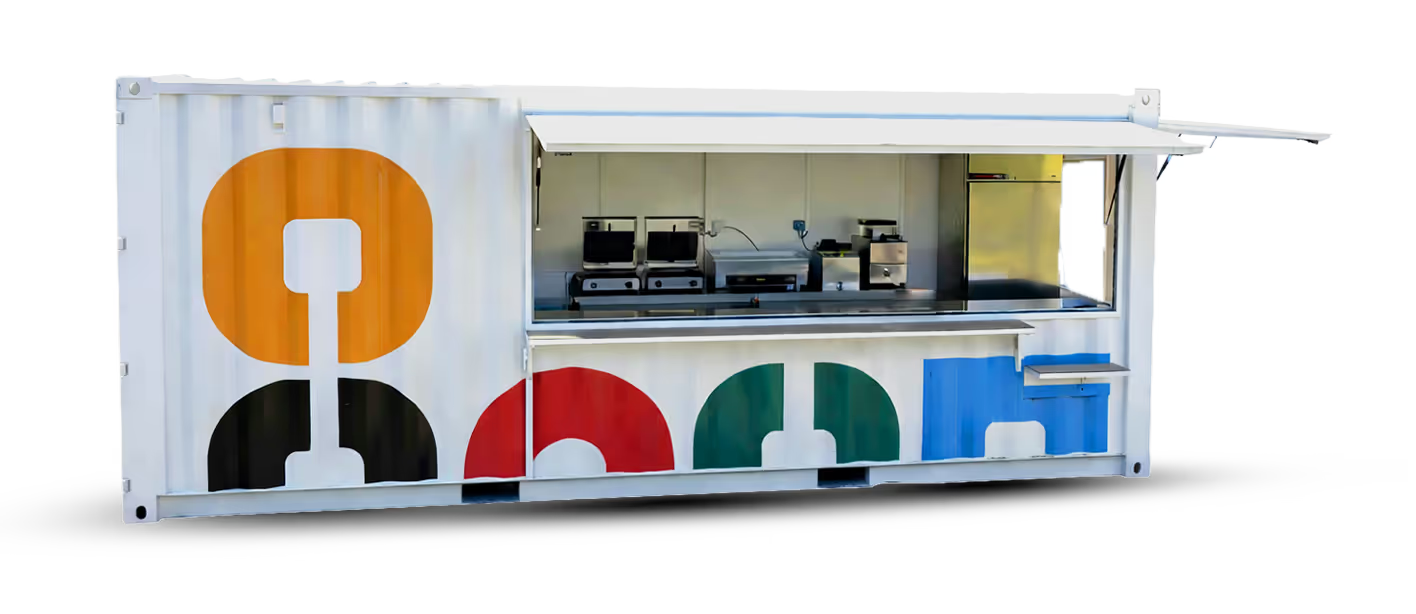
- 2 food trucks: Oiry & Case Mandois
- On-site meal preparation
- 6 modules at Case Mandois
- 14 modules in Oiry
- Related dining areas
- Nearly 10 years of trust


Every year, during the grape harvest, Champagne wineries must organize accommodations and meals for numerous crews during a particularly busy period. For a few weeks, the demand for meals increases sharply: meals must be prepared, served under appropriate conditions, and the harvesters must be provided with a proper break area right where they are working.
For nearly 10 years, LocaCuisines has been working with Sodexo at the Moët & Chandon sites, setting up two temporary kitchens specifically for this period: one in Oiry and the other at the Case Mandois site.
These facilities are not merely spaces for reheating food. They are full-fledged production kitchens, complete with areas where staff can eat their meals. Although this is a temporary solution, it is essential to ensuring that food service runs smoothly during the grape harvest.
A mobile kitchen to support a particularly busy grape harvest season
A temporary but essential need
The grape harvest involves a high volume of activity concentrated into a relatively short period. For several weeks, the teams work in the vineyards every day and need to be able to eat in suitable conditions.
For the teams organizing this food service, the challenge is therefore unique: they must temporarily establish significant production capacity without building infrastructure designed to operate year-round.
It is precisely in this context that a mobile kitchen comes into its own. It makes it possible to set up, for as long as necessary, a fully-fledged professional catering facility at a location that is not necessarily intended to have a permanent kitchen of that capacity.
However, the solution must meet the same organizational requirements as a traditional professional kitchen: production areas, storage, refrigeration, traffic flow, technical equipment, and the facilities necessary for the teams to operate.
Two sites, two configurations
To meet the needs of Sodexo and Moët & Chandon, two facilities are set up each year, in Oiry and Case Mandois.
The two kitchens do not have exactly the same layout. That is precisely one of the advantages of a modular design: the number of modules and their functions can be adapted to the site's constraints and the layout of the food service area.
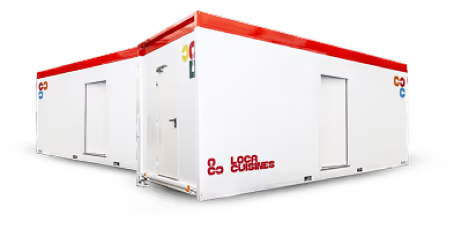
At Case Mandois, the system consists of 6 modules. At Oiry, the system is larger, with 14 modules, which allows it to handle a wider range of storage, circulation, and organizational functions.
These two projects demonstrate that a mobile kitchen does not necessarily have to be a standardized unit: it can be designed as a temporary, custom-built facility tailored to its intended use.
.webp)
.webp)
%20(1).webp)
Full-scale production kitchens, complete with a dining area
At Case Mandois: 6 modules for organizing production
The kitchen at Case Mandois consists of six units, combining several functions necessary for the teams’ daily operations and workflow.
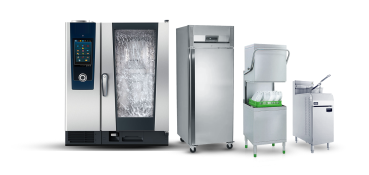
It includes, in particular, a fire-rated cooking module, a cold preparation area, a transfer chamber, and a dual-temperature (positive/negative) cold room. The facility also features a locker room with restroom facilities and a break room.
Each space therefore serves a specific purpose. The cooking and preparation areas enable on-site production, while the refrigeration equipment meets storage needs. The auxiliary facilities allow staff to work and take breaks in suitable conditions.
This setup makes it possible to create, using a limited number of modules, a fully functional temporary food production facility.
In Oiry: 14 modules to organize the entire farm
In Oiry, the needs call for a larger facility, with 14 modules.
The kitchen includes three cold storage rooms, a dry storage area, a break room, an office, a staff lounge, and a restroom. The facility also features six modules dedicated to circulation and neutral shipping.
These different spaces make it possible to organize the functions required for food service and the flow of people between the various areas.
This layout once again illustrates the benefits of a modular kitchen: the layout and organization can be adapted to meet specific needs, rather than requiring the same infrastructure at every location.
Producing on-site and hosting the grape pickers
The purpose of these facilities is indeed to have a production kitchen, not just a place where meals are served.
Meals are prepared on site by the catering staff. The kitchen is thus the heart of the operation, and a dining area is attached to it so that the grape pickers can eat their meals.
This proximity between food preparation and dining facilitates the organization of service and allows for the creation of a truly temporary space: a kitchen for preparing food, an area for serving, and a place to accommodate the staff.
For the grape pickers, this setup also provides a much-needed break. After several hours of work in the vineyards, being able to eat on-site in a designated area contributes to a welcoming environment and the well-being of the teams.
A temporary solution that provides flexibility for Moët & Chandon and Sodexo
Infrastructure tailored to seasonal demand
Building a permanent kitchen to meet a need that is concentrated over just a few weeks wouldn't necessarily make sense.
Renting, on the other hand, allows you to have professional facilities available only for as long as you need them. The kitchen is set up before the start of the season, used during the grape harvest, and then taken down once the season is over.
For the customer, this approach offers real flexibility: there's no need to set up a permanent infrastructure to handle seasonal spikes in activity.
Mobile kitchens are therefore a particularly effective solution for businesses whose catering needs fluctuate significantly throughout the year.
A system designed to address the actual challenges of the site
A temporary kitchen must be able to blend into the existing environment while allowing the food service teams to work efficiently.
The selection of modules, their layout, and how they are integrated are therefore critical. Requirements for production, storage, refrigeration, circulation, staff facilities, and dining areas must be taken into account from the design phase onward.
It is this approach that makes it possible to move from a simple arrangement of modules to a fully-fledged temporary food service infrastructure.
In Oiry, as in Case Mandois, the facilities are thus tailored to the specific characteristics of each site.
A temporary solution to promote employee well-being
Beyond the technical challenge lies, above all, a human one.
The grape harvest is a demanding time, with teams working daily at a physically strenuous pace over a short period. Ensuring that their meals are provided under good conditions is therefore an important part of the overall organization of the season.
The kitchen allows meals to be prepared right on site, and the adjoining area gives staff a place to relax, eat, and take a real break.
The solution is temporary, but it serves a very practical purpose: it helps create good conditions for meal service during a time when the staff is particularly busy.
.webp)
.webp)
Nearly 10 Years of Partnership with Moët & Chandon
A partnership renewed each year
This project has one notable feature: LocaCuisines has been supporting grape harvest sites for nearly 10 years.
Every year, kitchens are set up to meet the needs of the grape harvest. This annual process allows us to build on the experience gained over the seasons and to fully understand the challenges associated with this type of temporary facility.
For LocaCuisines, this is also concrete proof of the model's effectiveness: a mobile kitchen must be able to meet the demands of a professional operation, even when it is used for only a few weeks.
Thank you to Moët & Chandon and Sodexo for their continued trust over the past nearly 10 years.
Expertise Built Through Hands-On Experience
Since 1996, LocaCuisines has been supporting professionals who need temporary kitchens and catering equipment. This experience allows us to approach each installation with a perspective that goes beyond simply renting out modules.
A temporary kitchen must be designed with its actual use in mind: food preparation, storage, traffic flow, staff, utility connections, operation, and dismantling.
It is this approach that allows us to offer solutions tailored to both the harvest season and other temporary needs: event catering, kitchen closures, construction, disasters, seasonal operations, or temporary increases in capacity.
A mobile kitchen—just for a few weeks… but essential during the season
The Moët & Chandon facilities perfectly illustrate the benefits of a mobile kitchen.
For a few weeks, 6 modules in Case Mandois and 14 modules in Oiry will serve as fully operational production and catering facilities. They will enable Sodexo’s teams to prepare meals on site and organize meal service for the grape pickers.
Then, once the grape harvest is over, there is no longer a need for it, and the equipment can be dismantled.
A temporary solution in terms of duration, but a truly professional tool for as long as it is needed.
For businesses with temporary or seasonal catering needs, LocaCuisines can design a setup tailored to the site, the number of meals to be prepared, and the duration of operations.
Do you need a mobile kitchen for a season, an event, or a temporary activity? Let’s discuss your project.